What Is a Commander Deck in Magic: The Gathering?
A Commander deck is a 100-card Magic deck led by one legendary commander, with one copy of each card. The rules, life totals and color identity explained.
We earn from qualifying purchases through links on this page. How we make money.
A Commander deck is a 100-card Magic: The Gathering deck built around one legendary card, the commander, that starts the game in its own zone. Every card except basic lands is a single copy, every card must match the commander’s colors, and each player starts at 40 life. Commander is a multiplayer format, usually played four at a table.
The Commander deck building rules
The Commander deck building rules come down to three limits, all set out in the Comprehensive Rules and on Wizards of the Coast’s format page:
| Rule | What it means for your deck |
|---|---|
| 100 cards exactly | 99 cards plus the commander, never more or fewer |
| One copy of each card | Every card has a different name, except basic lands |
| Color identity | Every card uses only mana symbols that appear on the commander |
| A legendary commander | Usually a legendary creature, picked before the game |
Wizards describes the format as “all about picking your hero and building a deck around them.” The commander sets the colors and usually the plan: a commander that rewards Dragons leads a deck full of Dragons.
Commander also lets you use cards from across the game’s history, so a deck can mix a card printed in the 1990s with one from the newest set.
How color identity limits a Commander deck
Color identity is the rule that decides which cards fit a deck. A card’s color identity comes from every mana symbol on it, in its cost and in its rules text. Each card in the deck may only use mana symbols that also appear on the commander, and colorless cards are always allowed.
A green commander therefore allows green and colorless cards only. A commander with white and blue symbols opens up white, blue, white-blue and colorless cards. This is why players pick the commander first and the rest of the deck second.
Ready-to-play Commander decks
Live listings, shown by eBay
Opens eBay in a new tab. Check condition, seller feedback and returns.
How a game of Commander plays out
A game of Commander starts with each player putting their commander face up in the command zone and drawing seven cards. Every player starts with 40 life, and turns go clockwise around the table. You can attack any opponent, or several opponents in one combat.
The commander can be cast from the command zone at any time you could cast it. Each time it returns there and you cast it again, it costs two more mana than the last time; players call this the commander tax. If the commander would go to your hand, library, graveyard or exile, you may return it to the command zone instead.
The 21-damage rule
Wizards suggests about 20 minutes per player, so a four-player game runs about an hour and a half.
Commander Brackets for matching decks at a table
Commander Brackets are an optional system from Wizards for matching decks of a similar strength. There are five brackets: 1 Exhibition, 2 Core, 3 Upgraded, 4 Optimized and 5 cEDH. Brackets 1 to 3 are for casual, social games, and brackets 4 and 5 are for high-power and competitive play.
The brackets lean on a Wizards list of especially strong cards that can take over a game. Bracket 1 and 2 decks play none of the listed cards, bracket 3 allows up to three, and brackets 4 and 5 allow any number. Before a game, players simply say which bracket their deck is in.
Where a new player gets a Commander deck
A new player gets a Commander deck in one of two ways: buy a preconstructed deck or build one from single cards. A preconstructed deck, or precon, comes ready to play with 100 cards, tokens and a deck box. The Foundations Commander decks, released on October 2, 2026, are five one-color precons made to teach the format.
Building your own deck starts with picking a commander and checking its color identity. The step-by-step version is in how to build a Commander deck, and the decks made for new players are compared in Foundations Commander decks.
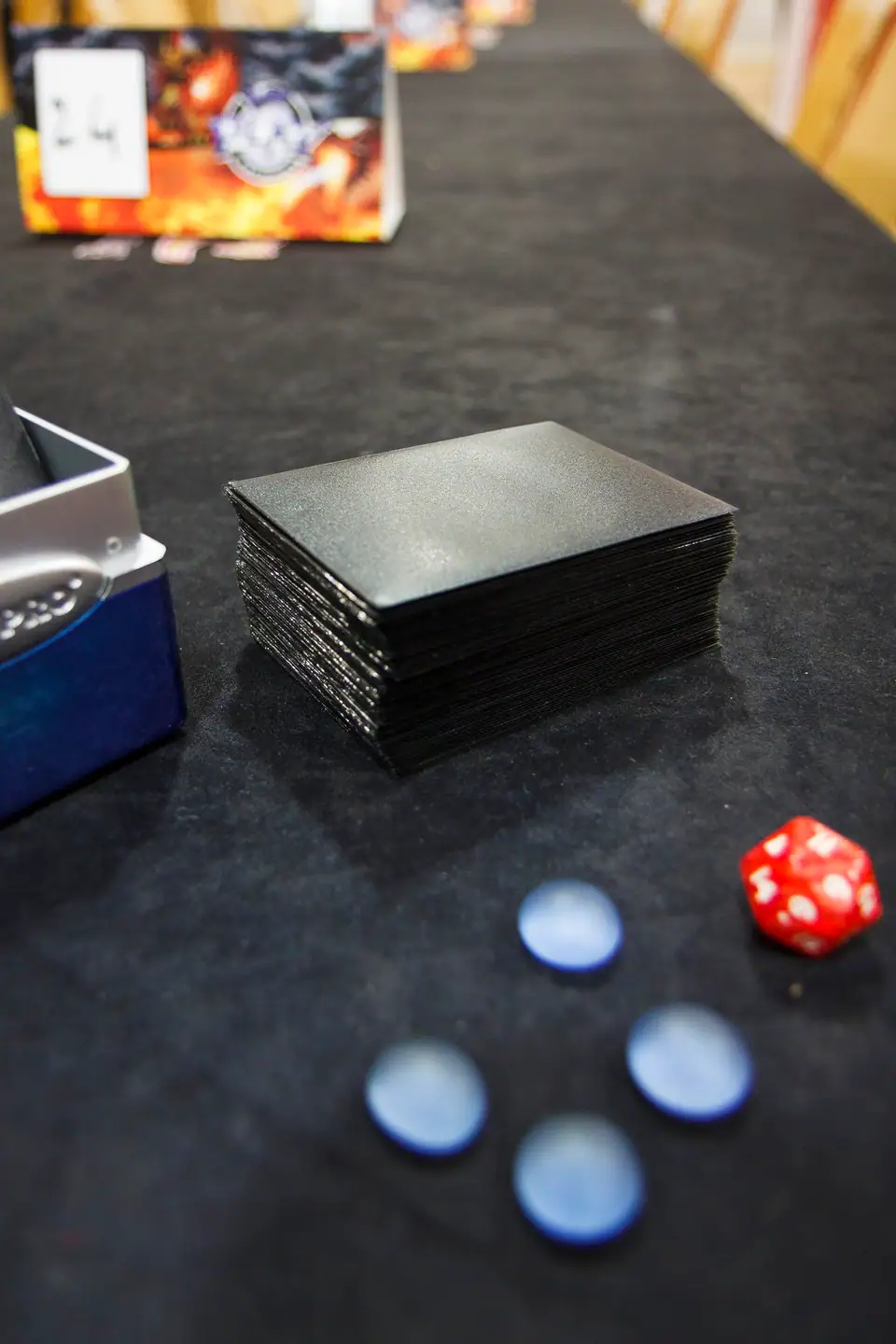
A sleeved 100-card deck is thicker than a 60-card one, so it needs a deck box sized for it.
Deck boxes that hold 100 sleeved cards
Live listings, shown by eBay
Opens eBay in a new tab. Check condition, seller feedback and returns.
More Commander guides
Every Commander guide on this site is collected in the Commander precon hub, which compares the current decks. To see how Commander sits next to Standard, Modern and the draft formats, read Magic: The Gathering formats explained.
Frequently asked questions
How many cards are in a Commander deck?
A Commander deck has exactly 100 cards, and that count includes the commander. The Comprehensive Rules set 100 as both the minimum and the maximum, so the deck is never 99 or 101.
Can a Commander deck have two copies of a card?
No. Other than basic lands, every card in a Commander deck must have a different English name. You can play as many Plains, Islands, Swamps, Mountains and Forests as you like.
Can Commander decks be used in Standard?
Not as they come. Standard decks need at least 60 cards with up to four copies of a card, from recent sets only. A preconstructed Commander deck holds many older reprints that are not Standard legal, so it plays Commander, not Standard.
How much life do you start with in Commander?
Each player starts a Commander game with 40 life, twice the 20 life of a normal game. A player also loses after taking 21 combat damage from the same commander.
Sources
- MTG Commander FormatWizards of the Coast
- Magic: The Gathering Comprehensive Rules (effective September 25, 2026), rules 103.4 and 903Wizards of the Coast
- Reality Fracture Buyer's Guide for CommanderWizards of the Coast
Filed under Commander decks and precons